
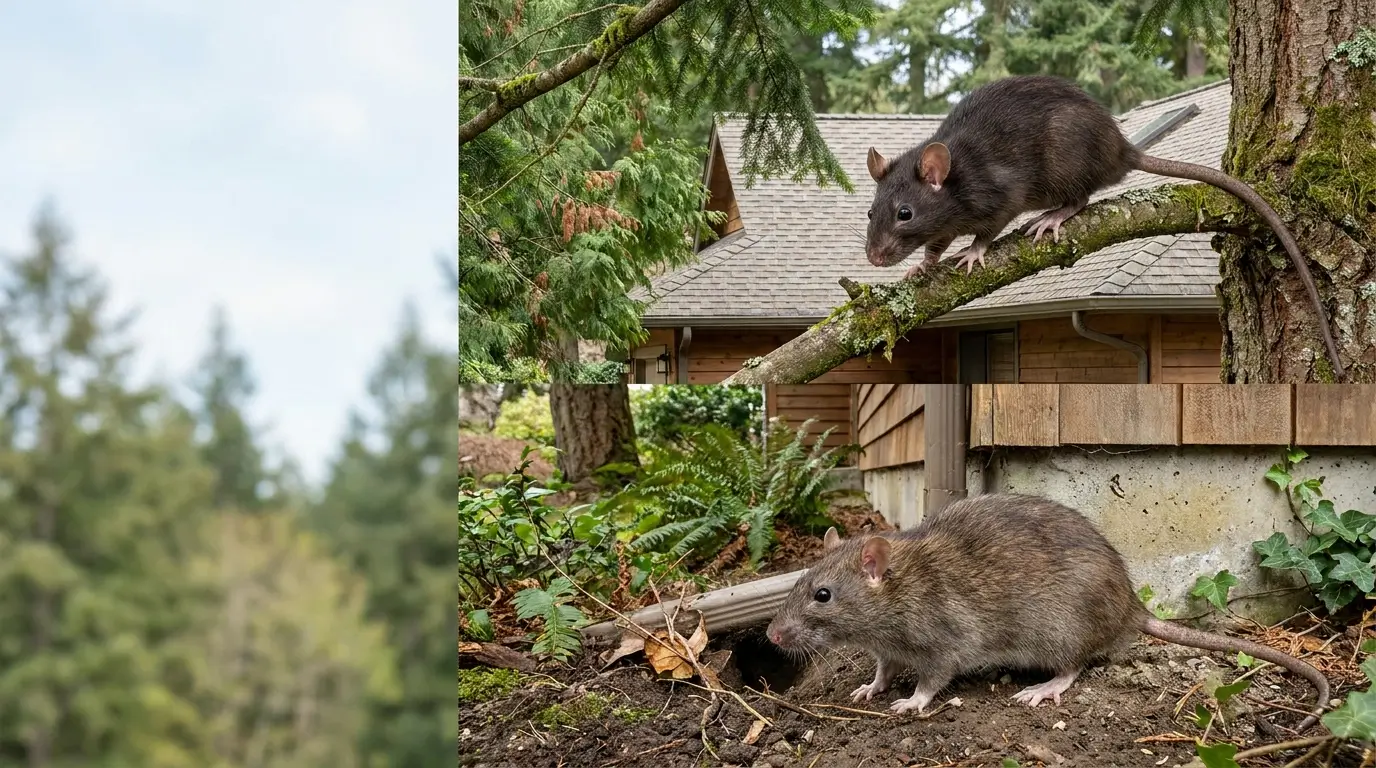
If you have rats in or around your Renton home, you may wonder which kind you are dealing with. Two species matter most in our region: the Norway rat and the roof rat. They look similar at a glance, but they nest in different places, enter buildings differently and call for different approaches.
People often ask which one is “more common” here. There is no simple answer, and we will not guess at numbers. The mix varies from neighborhood to neighborhood, and the only reliable way to know which species is on your property is an on-site inspection. What we can do is explain how each one behaves, so you know what clues to look for.
Meet the Norway Rat
The Norway rat, also called the brown rat or sewer rat, is the stockier of the two.
Appearance
- Heavy, thick-bodied animal with a blunt snout
- Fur is usually brown or gray-brown, with a lighter underside
- Tail is shorter than the head and body combined
- Small, close-set ears
Habits
- Ground-level and below. Norway rats tend to burrow in soil and nest in basements, crawl spaces, beneath slabs, sheds, decks and along foundations.
- Water-adjacent. They are often found near drainage, creeks, ditches and sewer systems.
- Opportunistic feeders. Garbage, pet food, bird seed, compost and spilled food are all attractive.
- Droppings. About 1/2 to 3/4 inch, blunt-ended.
Western Washington’s damp climate, waterways and mature landscaping give them plenty of potential harborage. For more on how to deal with them, see Norway rat removal in Renton.
Meet the Roof Rat
The roof rat, also called the black rat, is sleeker and more agile.
Appearance
- Slim body with a pointed snout
- Fur ranges from black to brown or gray
- Tail is longer than the head and body combined
- Large, prominent ears and eyes
Habits
- Climbers. Roof rats are skilled at moving along wires, fences, tree branches and rooflines.
- High nesting. They tend to nest in attics, rafters, soffits, dense vegetation, trees and the upper parts of buildings.
- Food preferences. They favor fruit, nuts, seeds and ornamental plants, though they will eat many foods. Backyard fruit trees can be a draw.
- Droppings. Generally smaller and more spindle-shaped than Norway rat droppings, but still larger than mouse droppings.
For more on handling them, see roof rat removal in Renton.
Quick Comparison
- Body: Norway is heavy and stocky; roof rat is slim and lean.
- Tail: Norway’s is shorter than its body; the roof rat’s is longer.
- Ears and snout: Norway has small ears and a blunt snout; roof rat has large ears and a pointed snout.
- Typical nesting height: Norway tends to be low or underground; roof rat tends to be high.
- Movement: Norway burrows and runs along the ground; the roof rat climbs and travels overhead.
These are general tendencies, not rules. Rats are adaptable, and either species can turn up outside its usual pattern. A Norway rat may climb into an attic, and a roof rat may be found in a basement.
Which Is More Common Here?
It depends on where you are. Neighborhoods differ in housing age, landscaping, proximity to water and greenbelts, nearby food sources and commercial areas, and all of this shapes what lives there. One block may have mostly Norway rats while another, with fruit trees and overhead utility lines, may see roof rats. Rather than assuming, the better approach is to look at the evidence on your own property.
Clues That Help Identify the Species
Even without seeing the animal, signs can point one way or another.
Pointing Toward Norway Rats
- Burrow holes along foundations, under slabs, decks or sheds
- Activity in basements, crawl spaces or ground-floor areas
- Rub marks and runways along the base of walls
- Gnawing at ground-level openings
Pointing Toward Roof Rats
- Scratching or running sounds in the attic or ceiling, particularly at night
- Gnawed fruit or nuts left in trees or on the ground
- Activity along fences, wires and branches touching the roof
- Droppings in the attic, on rafters or on top of walls
Common to Both
- Droppings, urine odor and greasy smears
- Gnawed packaging and wiring
- Nesting material such as shredded insulation and paper
Why Knowing the Species Matters
Correct identification shapes the plan:
- Where to look for entry points. Norway rats usually enter near the ground, while roof rats often come in from above through rooflines, vents and soffits.
- Where to set up control measures. The right placement depends on how each species travels.
- What to seal and how. Rats can pass through gaps of about 1/2 inch, so openings must be closed with durable materials. Our page on rodent exclusion explains more.
- What to clean up. Roof rat contamination tends to be concentrated in attics, Norway rat contamination in crawl spaces and basements. See attic cleanup and crawl space pages.
For a wider look at species and the health considerations involved, see our guide to rodent species and diseases.
Practical Tips for Any Rat Problem
- Remove food sources. Secure garbage, pet food and bird feeders, and pick up fallen fruit.
- Cut off the highways. Trim branches back from the roof and keep vegetation away from walls.
- Reduce harborage. Clear debris, stacked wood and clutter near the house.
- Seal entry points at the foundation, rooflines, vents and utility penetrations.
- Fix water issues. Repair leaks and clear gutters.
- Handle droppings safely. Never dry sweep or vacuum. Ventilate, wear gloves and a respirator, and wet-disinfect. See our guide to safe rodent dropping cleanup. The Washington State Department of Health and the CDC recommend this approach.
When to Call a Professional
Consider professional help if:
- You see or hear rats and are not sure of the species
- Activity is in the attic, walls or crawl space
- You find burrows, large amounts of droppings or gnawing
- Previous efforts have failed or rats keep coming back
- Rats are using trees, wires or neighboring properties to reach your home
- You manage a property where rats may affect several units
A provider can inspect the property, identify the species and build a plan around how those animals actually move.
Need Help Finding a Provider?
Renton Rodent Control is a referral service that connects homeowners, renters and property managers in Renton and King County with independent pest-control providers where coverage is available. Availability, services and pricing vary by provider and location. Request a Connection
Quick FAQ
Which rat is more common in the Pacific Northwest? It varies by neighborhood and property, so we do not cite prevalence. An on-site inspection is the best way to identify the species at your address.
Do roof rats only live on roofs? No. They prefer high places, but they can also be found at ground level.
Can I tell the species from droppings alone? Droppings offer clues but are not definitive. Size, location and other signs together give a clearer picture.
Are rats dangerous? Rats can carry germs and cause damage. Use safe cleanup practices and consult the Washington State Department of Health or the CDC for health guidance.
This article is for general education only and is not a substitute for an on-site inspection or professional or medical advice. Renton Rodent Control is an independent referral service and does not provide extermination or repair services.