
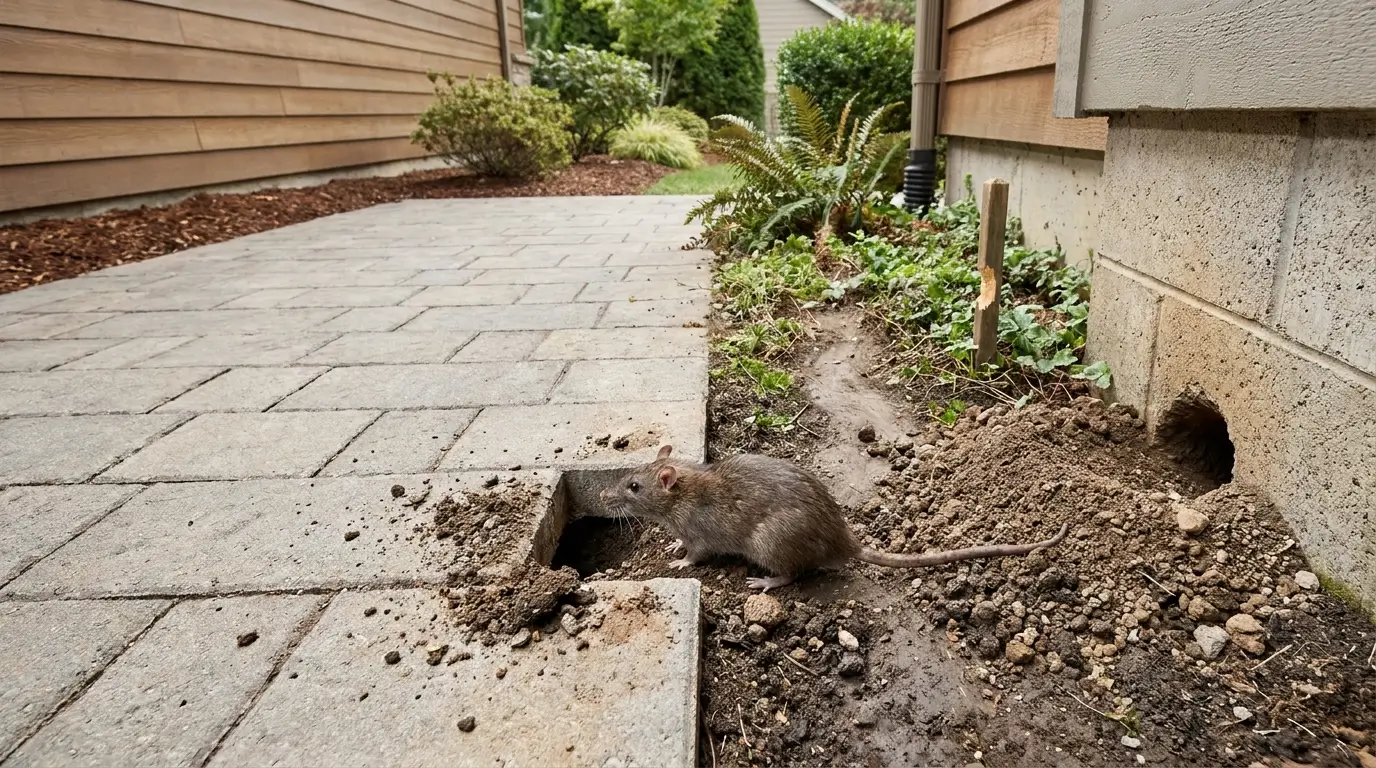
Not every rat problem starts in the attic. Norway rats are burrowing animals, and they frequently dig beside foundations, beneath concrete slabs and patios, and under sheds, decks, and woodpiles. From there, they can find the smallest gap into a crawl space, basement, or wall.
Finding burrows early gives you a chance to act before rats move indoors. This guide explains what rat burrows look like, how to tell them apart from other holes in the yard, and what to do and not do when you find one.
Why Rats Dig Next to Buildings
Burrows offer shelter from predators and weather, a place to nest and raise young, and quick access to food. A foundation wall or slab gives them solid cover on one side, and soil that is loose, damp, or disturbed is easy to excavate. In the Pacific Northwest, rainy weather can send rats looking for drier ground, and the soil beside a house is often a convenient choice.
Burrowing is most closely linked to Norway rats. Read more about them on our Norway rat removal page, and see our comparison of roof rats and Norway rats for how the two differ.
What a Rat Burrow Looks Like
Rat burrow openings are usually about 2 to 3 inches across, roughly the width of an adult rat’s body, though they can look larger when the edges crumble. Typical features include:
- Smooth, rounded entrance with packed soil along the edges from repeated travel
- Little or no loose dirt in a mound at the opening, unlike some other burrowing animals, because rats often kick soil to the side or backfill
- Worn, polished soil or grass leading to the hole, known as a runway
- Fresh dirt around a new hole, and cobwebs or debris inside an abandoned one
- Multiple openings in the same area, since burrow systems often have several entrances and bolt holes
An active burrow tends to look clean and used. A hole with spider webs, leaves, or plant growth across the entrance may be abandoned.
Where to Look
Along Foundations
Check the full perimeter where the soil meets concrete or siding. Look for holes at the base of the wall, near vents, around pipe and cable penetrations, and under window wells.
Under and Around Patios and Slabs
Cracked or settled concrete is a favorite spot. Rats can dig under a slab edge and use gaps between pavers or where a patio meets the house.
Beneath Decks, Steps, and Sheds
The dark, sheltered space under a deck or outbuilding is ideal. Stored items, firewood, and lumber piles add cover.
Near Food and Water
Burrows tend to cluster near sources: bird feeders, pet food, compost, garbage cans, fruit trees, chicken coops, and leaking hose bibs or irrigation.
Along Fences and Landscaping
Dense ground cover, ivy, and thick shrubs hide openings. Run a gloved hand-held tool such as a rake through the vegetation rather than reaching in with your hands.
Other Holes You Might Find
Not all holes are rats. Consider:
- Voles: Smaller entrances, about 1 inch, with surface runways through grass.
- Moles: Raised tunnels and volcano-shaped dirt mounds, with no open hole.
- Mice: Small holes, around 1 inch or less, often in protected areas.
- Chipmunks or ground squirrels: Where present, holes may be cleaner and sometimes near rocks or logs.
- Insect nests or drainage gaps: Smaller openings with sandy or crumbly material.
Size is not definitive, so look for supporting signs such as droppings, gnawing, and runways. Rat droppings are about 1/2 to 3/4 inch long with blunt ends, versus about 1/8 to 1/4 inch and pointed for mice.
Signs That a Burrow Is Active
- Fresh droppings near the opening
- Smooth, packed soil or visible greasy rub marks on nearby concrete or wood
- Gnawed material, food waste, or seeds near the entrance
- Fresh digging after rain or overnight
- Rats seen entering or leaving at dusk or dawn
- Sounds from walls or under floors indoors
One practical test used by professionals is lightly loosening or stuffing a hole and checking whether it is reopened. If you try this, wear gloves and keep to a quick visual check. Avoid sealing holes permanently on your own, because it may push the rats elsewhere and does not address why they are there.
What to Do If You Find a Burrow
- Do not pour chemicals or fuel into the hole. This is hazardous to you, pets, soil, and groundwater, and it is not an effective approach.
- Do not use poison without guidance. Pets, children, and wildlife can be harmed, and rats may die in places you cannot reach.
- Document it. Take photos with something for scale, and note locations and the date.
- Remove attractants. Secure garbage, remove spilled seed and pet food, clear fallen fruit, and fix leaks.
- Reduce cover. Move woodpiles away from the house, trim dense vegetation, and keep a clear strip along the foundation.
- Inspect for entry points. Rats need about 1/2 inch to get in. Check vents, pipe gaps, damaged screens, and crawl space openings. See rodent exclusion.
- Handle cleanup safely. If you find droppings, never dry sweep or vacuum. Ventilate, wear gloves and a respirator, and wet-disinfect, as described in our safe cleanup guide.
Why Burrows Matter for the House
Burrows beside a foundation can undermine soil and slab edges over time, and they give rats ready access to your crawl space, where they can damage insulation, ductwork, and wiring. A burrow also signals that there is enough food and shelter nearby to support breeding, so activity can grow quickly if nothing changes.
When to Call a Professional
Call a professional if you find multiple burrows, burrows along the foundation, any sign that rats have entered the crawl space or walls, or recurring activity after you have cleaned up food and clutter. A professional can confirm the species, trace the burrow system, and combine removal with sealing and prevention. If you are a landlord or property manager, shared yards and dumpsters may need coordinated action.
Need Help Finding a Provider?
Renton Rodent Control is a referral service that connects homeowners, renters, and property managers in Renton and King County with independent pest-control providers where coverage is available. Availability, services, and pricing vary by provider and location.
Quick FAQ
How big is a rat burrow entrance? Typically about 2 to 3 inches across, though edges can wear wider.
Can I just fill the hole with soil? Filling a hole rarely solves the problem and may push rats to dig a new one or force them into a structure. It is better to find out why they are there and have it addressed properly.
Do rat burrows mean rats are in my house? Not necessarily, but burrows near a foundation raise the risk. Check for entry gaps and listen for noises indoors.
Are rats dangerous to be near? Rodents can carry pathogens, and the Washington State Department of Health and the CDC advise avoiding direct contact with rodents and their droppings. See our rodent diseases page.
This article is for general education only and is not a substitute for an on-site inspection or professional or medical advice. Renton Rodent Control is an independent referral service and does not provide extermination or repair services.