
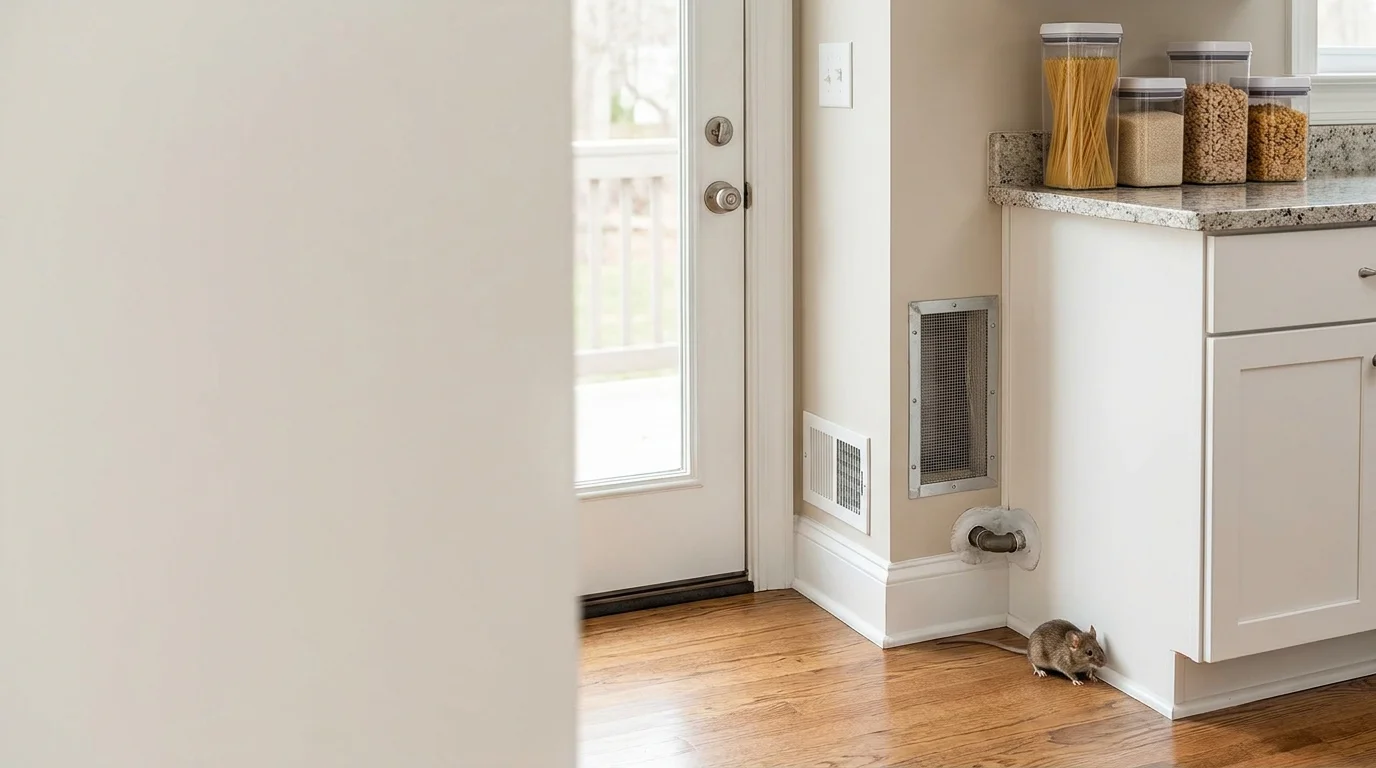
Mice do not need much. A warm corner, a little food and a gap about 1/4 inch wide, roughly the width of a pencil, is enough for a house mouse to move in. Once they settle, they breed quickly and are hard to dislodge, so prevention is far easier than cleanup.
This guide walks through ten practical steps you can take around a Renton or King County home. None of them is complicated, but together they remove the three things mice want most: a way in, something to eat and somewhere to hide.
Step One: Close the Doors Mice Use
1. Seal gaps around pipes, wires and vents
Check under sinks, behind the dishwasher and washer, and anywhere a pipe, gas line or cable passes through a wall or floor. Fill gaps with materials mice cannot chew through easily: tightly packed copper mesh or steel wool held in place with sealant or mortar, sheet metal flashing, or cement. Spray foam on its own is not a barrier, because mice can chew through it. For a deeper look at common gaps, see our guide to rodent exclusion.
2. Fix door sweeps and garage door seals
If you can slide a pencil under an exterior door, a mouse can follow. Replace worn sweeps and cracked rubber garage door seals, and check the corners where seals often pull away. Attached garages are one of the most common routes into the main house.
3. Screen vents and repair the foundation
Crawl space vents, dryer vents and foundation openings should have intact, securely fastened 1/4 inch galvanized hardware cloth or proper covers. Patch cracks in the foundation and gaps where the foundation meets the wood sill. If you suspect a problem under the house, our crawl space page explains what to look for.
Step Two: Remove the Food
4. Store pantry food in hard containers
Mice chew through cardboard, paper and thin plastic bags. Keep cereal, flour, rice, pasta, nuts, seeds and pet food in glass, metal or thick, tight-lidded plastic containers.
5. Clean up crumbs and spills
Sweep or wipe up crumbs under the toaster, around the stove and beneath appliances. Wash dishes promptly and do not leave dirty dishes out overnight. A few crumbs a night is a reliable meal for a mouse.
6. Manage pet food and trash
Pick up pet food bowls at night when practical, and keep bulk pet food sealed. Use trash cans with tight lids, take kitchen trash out regularly, and rinse recycling containers so they do not smell of food.
Step Three: Take Away the Hiding Places
7. Declutter garages, basements and storage areas
Mice nest in stacked cardboard boxes, piles of paper, old fabric and undisturbed corners. Move to sealed plastic bins, keep items off the floor on shelves, and leave a little space along walls so you can see what is going on.
8. Keep firewood and debris away from the house
Store firewood off the ground and well away from the foundation. Clear leaf piles, scrap lumber and overgrown vegetation next to the house, which give mice cover as they approach your walls.
9. Trim trees and shrubs
Branches that touch the roof or siding act as bridges. Trim them back, and keep dense shrubs from growing hard against the foundation, where mice can run unseen along the wall.
Step Four: Stay Alert
10. Inspect regularly and act early
Twice a year, and especially before fall, walk the outside of the home with a flashlight and check the inside along baseboards, in cabinets and in the garage. Early signs include:
- Droppings about 1/8 to 1/4 inch long with pointed ends, often found along walls and in drawers
- Gnaw marks on food packaging, wood or wiring
- Shredded paper, fabric or insulation used as nesting material
- Scratching or scurrying sounds in walls or ceilings, often at night
- A musty, ammonia-like smell in enclosed spaces
The Pacific Northwest’s wet fall and winter weather drives mice indoors, so that is when these signs most often appear. To learn more about the species involved, read about house mouse control and deer mouse control.
A Note on Cleaning Up After Mice
If you find droppings or nests, do not sweep or vacuum them dry, because that can send dust into the air. Ventilate the area, wear gloves and a respirator, and wet the droppings with disinfectant before wiping them up. Our guide to safe rodent dropping cleanup covers the steps, and the Washington State Department of Health and the CDC publish detailed guidance. Deer mice can carry hantavirus, which is another reason to avoid raising dust; see our hantavirus guide.
When to Call a Professional
DIY prevention works well for small, easy-to-reach problems. It is worth getting professional help when:
- You keep seeing signs of mice after sealing the obvious gaps.
- You hear activity in an attic, wall or crawl space and cannot find where it is coming from.
- The entry points are high, hard to reach or hidden, such as roof vents and tight crawl spaces.
- There are large amounts of droppings, nesting material or damaged insulation.
- You are unsure whether you are dealing with mice or rats.
A professional can inspect the whole building, find entry points you may miss and decide whether trapping, exclusion or both are needed. Sealing a house with mice still inside can trap them in the walls, so inspection comes first. More on mice control is available on our site.
Need Help Finding a Provider?
Renton Rodent Control is a referral service. We do not perform pest control ourselves. We connect homeowners, renters and property managers in Renton and King County with independent pest-control providers, where coverage is available. Provider availability, services and pricing vary.
Request a Connection
Quick FAQ
How small a gap can a mouse squeeze through?
About 1/4 inch, roughly the width of a pencil. A rat needs about 1/2 inch.
Will peppermint oil or ultrasonic devices keep mice away?
They are not a reliable substitute for sealing entry points and removing food. Physical exclusion and sanitation are what work over the long term.
When are mice most likely to come indoors?
Fall and winter are the busiest seasons in the Pacific Northwest, but mice can be active year-round.
Do I need to find every entry point myself?
Not necessarily. A thorough inspection by a pest-control provider is often the fastest way to find the less obvious gaps. See our FAQ for more.
Disclaimer: This article is for general education and does not replace an on-site inspection or professional or medical advice. Renton Rodent Control is an independent referral service and does not provide extermination or repair services.