
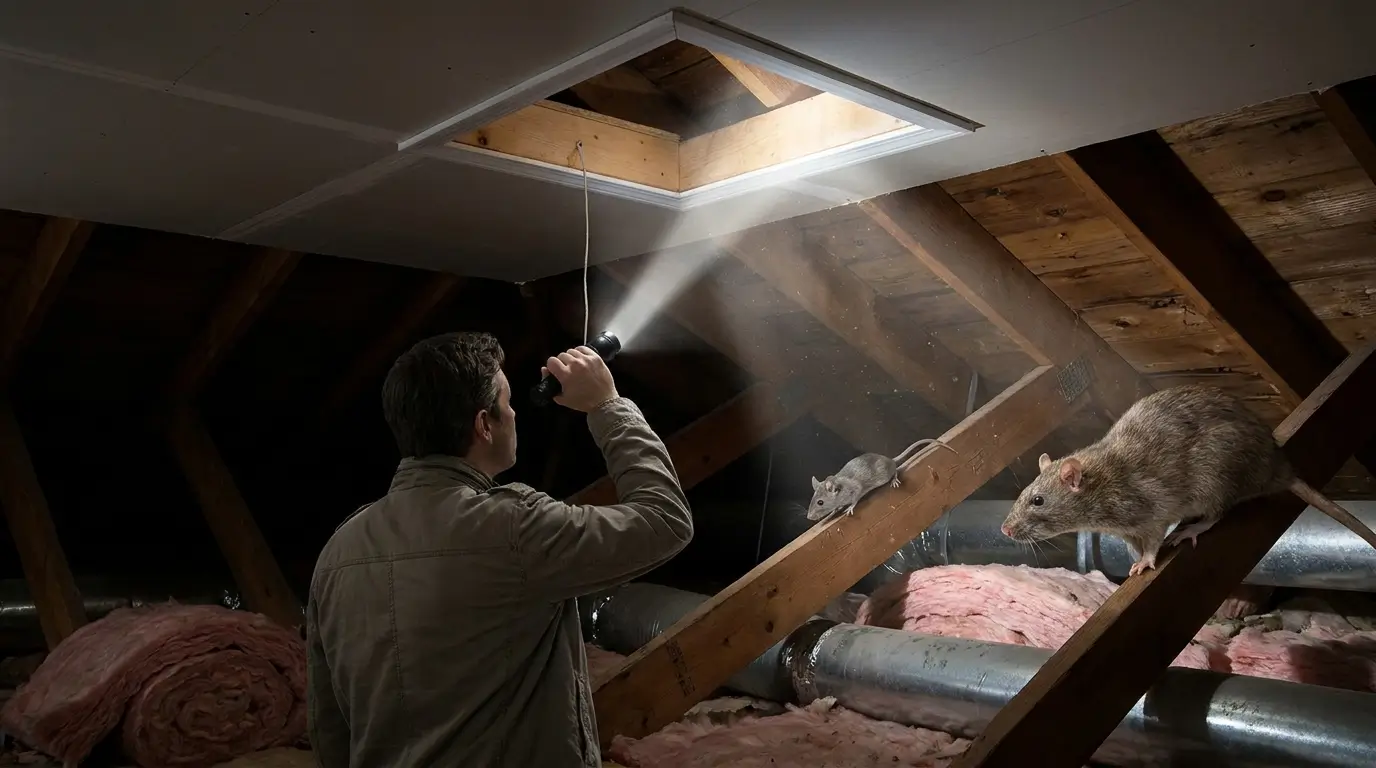
You are lying in bed and hear scratching, scampering or a dull thump overhead. It is a common experience in Renton and across King County, especially from fall through winter, when animals look for warm, dry shelter. The first question is usually whether it is a rat or a mouse, and the answer changes how serious the problem is likely to be.
Sound is only one clue, and it can mislead. This guide explains what rat and mouse noises tend to sound like, what other evidence to look for, which other animals can make similar sounds, and when to bring in a professional.
Why Noises Happen at Night
Rats and mice are mostly nocturnal. They rest in nests during the day and move around, forage and groom after dark, when the house is quiet. That is why you hear them as you settle down for the night or very early in the morning. Hearing noise in the daytime is less typical and can suggest a larger population or a disturbed nest, though it is not proof.
What Rat Noises Tend to Sound Like
Rats are heavier animals, and their sounds usually reflect that.
- Heavier scurrying or thumping as they run across ceiling joints or insulation.
- Louder gnawing or scraping from chewing on wood, pipes or wiring.
- Rolling or dragging sounds as they move food, nesting material or debris.
- Squeaking and fighting when several rats share a space.
Roof rats often nest high, so overhead activity along rafters and in the attic fits their habits. Norway rats more often stay lower but can reach attics too. Our pages on roof rats and Norway rats describe both.
What Mouse Noises Tend to Sound Like
Mice weigh very little, so the sounds are lighter and quicker.
- Light, fast scratching or pattering, like tiny feet.
- Faint gnawing or nibbling, often inside wall voids.
- Rustling in insulation or stored boxes.
- High, thin squeaks, which can be hard to hear from another room.
Mice usually need only a gap of about 1/4 inch to get in, and they nest almost anywhere. See our mice control page and guides to house mice and deer mice for more.
Look Beyond the Sound
Noise gives you a hint, but physical evidence is far more reliable.
Droppings
- Mouse droppings: about 1/8 to 1/4 inch long, small and pointed.
- Rat droppings: about 1/2 to 3/4 inch long. Norway rat droppings are blunt; roof rat droppings tend to be somewhat smaller with pointed ends.
If you see droppings, do not sweep or vacuum them dry. See the safety steps below.
Other signs
- Gnaw marks: Larger, deeper marks suggest rats; fine, small marks suggest mice.
- Grease or rub marks: Dark smears along beams, pipes and entry holes appear with either species, and are often heavier with rats.
- Nesting material: Shredded insulation, paper or fabric in a hidden corner.
- Tracks and runways: Light dust on joists may show trails or tail drag.
- Smell: A stale, musky or ammonia-like odor builds up where rodents live.
It Might Not Be a Rodent
Several other animals use attics in the Pacific Northwest and make noise overnight or at dawn:
- Squirrels are mainly active by day, with heavier thumping and rolling sounds early in the morning.
- Raccoons can sound like heavy thumping or dragging and may chitter or growl.
- Opossums are slow, heavy movers.
- Bats make faint scratching and squeaking, usually near dusk and dawn.
- Birds make fluttering and chirping, often in vents or eaves.
- Building sounds such as ducts, pipes and roof materials expanding and contracting with temperature changes.
Because some of these animals are protected or need different handling, it pays to identify the source before acting.
What You Can Do Tonight and This Week
- Note the pattern. Write down the time, location and type of sound over several days.
- Check for droppings and damage at the attic access with a flashlight, wearing gloves and a respirator if you go in.
- Inspect outside. Look for gaps at vents, soffits and rooflines, and for tree limbs touching the house.
- Remove attractants. Secure food, garbage and pet food, and pick up fallen fruit.
- Do not seal everything blindly. Closing up a home with animals still inside can trap them in the walls.
- Avoid DIY poison. Poison can lead to animals dying in places you cannot reach, which brings odor problems. Read our dead rat smell page to understand why.
Cleaning Up Safely
If you find droppings or nesting material, never dry sweep or vacuum them. Ventilate the area, wear gloves and a respirator, and wet-disinfect, following Washington State Department of Health and CDC guidance. Our safe cleanup guide walks through the steps, and our hantavirus guide explains why caution matters.
When to Call a Professional
Call for help when:
- Noises continue night after night or are getting louder.
- You cannot tell whether the cause is a rat, a mouse or another animal.
- You find large amounts of droppings, damaged wiring or soaked or flattened insulation.
- The attic is hard to reach, low, steep or crowded with stored items.
- You smell decay or suspect an animal has died in a wall or ceiling.
A provider can inspect the attic and roofline, identify the animal, locate entry points and recommend next steps. See our rodent exclusion page and attic cleanup page.
Need Help Finding a Provider?
Renton Rodent Control is a referral service. We do not perform pest control ourselves. We connect homeowners, renters and property managers in Renton and King County with independent pest-control providers, where coverage is available. Provider availability, services and pricing vary.
Request a Connection
Quick FAQ
Are heavier noises always rats?
Not always. Rats tend to sound heavier, but squirrels, raccoons and other animals can too, so confirm with physical evidence.
Can mice make a lot of noise?
A few mice can sound surprisingly busy in a quiet house, even though each one is light.
What size are rat and mouse droppings?
Mouse droppings are about 1/8 to 1/4 inch and pointed. Rat droppings are about 1/2 to 3/4 inch, and blunt for Norway rats.
Should I go into the attic myself?
Only if it is safe to do so, with gloves, eye protection and a respirator. If in doubt, ask a professional.
Disclaimer: This article is for general education and does not replace an on-site inspection or professional or medical advice. Renton Rodent Control is an independent referral service and does not provide extermination or repair services.