
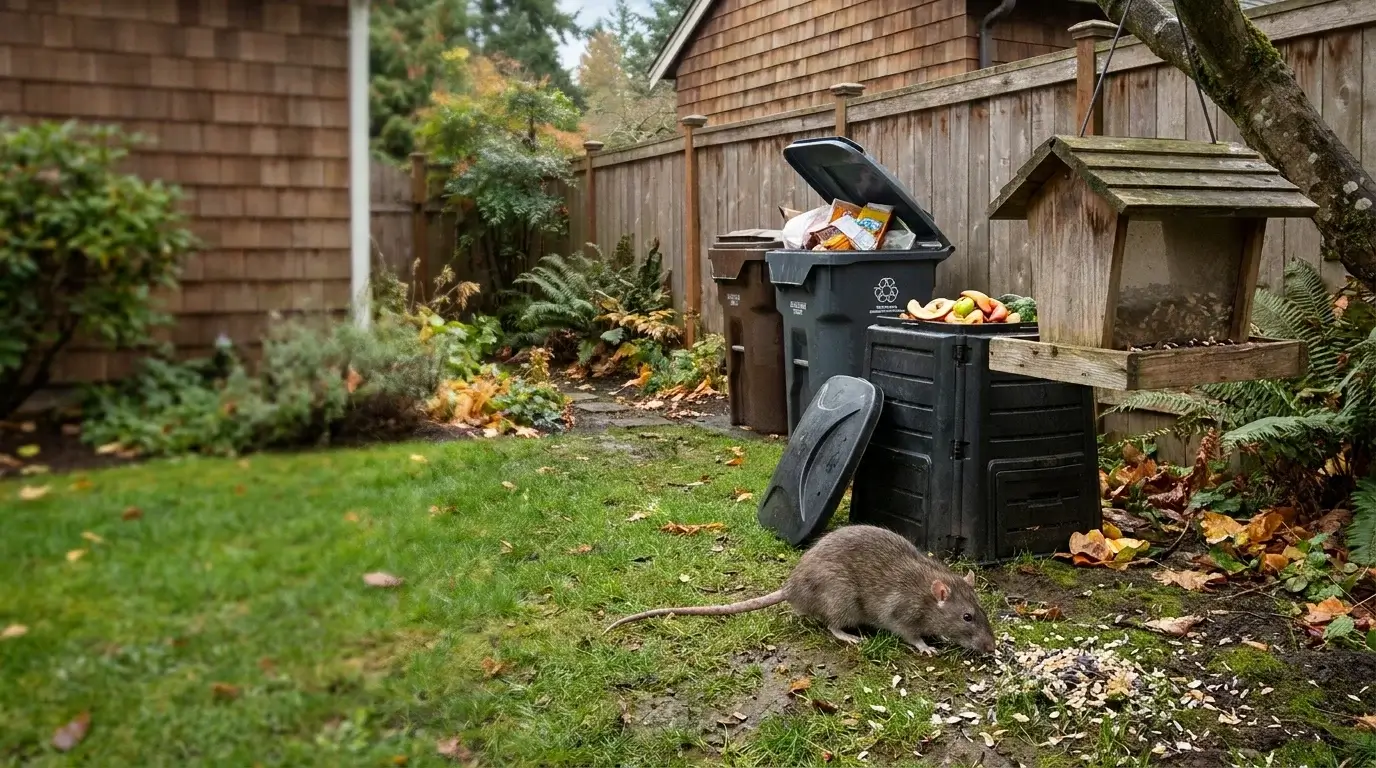
Rats rarely choose a yard by accident. They arrive because there is dependable food, water and cover nearby, and in many Renton neighborhoods the easiest meals come from things homeowners do with good intentions: filling a bird feeder, keeping a compost bin or leaving a trash can lid slightly ajar.
The good news is that rats are driven by access to food, so removing it is one of the most effective prevention steps. This article explains what draws rats to a property and what you can change without giving up your garden or your birds.
Why Food Sources Matter So Much
A rat can survive on very little, and Norway rats and roof rats both thrive near people. A reliable food source lets a small number of rats become a larger population. Once rats are comfortable in a yard, they explore for shelter, and a gap of only about 1/2 inch in a foundation, vent or roofline can lead them into the house.
In the Pacific Northwest, mild winters and plentiful rain mean yards stay green and food stays available for much of the year. To learn how the species differ, see our guides to Norway rats and roof rats.
Bird Feeders
Bird seed is high in fat and calories, which makes it very attractive to rats. Even if rats cannot climb the feeder, seed spilled on the ground becomes a steady supply. Roof rats are skilled climbers and can reach many hanging feeders.
What helps
- Choose feeders that catch spilled seed, or use a tray underneath and clean it daily.
- Offer only as much seed as birds eat in a day.
- Sweep up hulls and spilled seed regularly.
- Store seed in a metal or heavy-duty container with a tight lid, not in a paper or plastic bag in the garage.
- Place feeders away from fences, sheds and dense shrubs that give rats cover.
- If you see rats at the feeder, take it down for a few weeks to break the habit.
Compost Piles and Bins
Compost is useful, but the wrong materials turn a pile into a restaurant. Meat, fish, dairy, grease, cooked food and bread are especially attractive and should stay out of open or backyard bins.
What helps
- Use a fully enclosed bin with a secure lid and a solid or fine-mesh bottom, rather than an open pile.
- Keep food scraps buried under a layer of brown material such as leaves or shredded paper.
- Avoid adding meat, bones, dairy and oils.
- Turn the compost regularly and check around the base for burrow holes.
- Place bins away from the house foundation and from fences.
Garbage and Recycling Bins
Trash is one of the most common rat food sources in urban and suburban areas.
What helps
- Use bins with tight-fitting lids, and keep lids fully closed.
- Bag trash and avoid overfilling. Bags stacked beside the bin are an easy target.
- Rinse food containers before recycling them.
- Clean bins periodically so food residue and odors do not build up.
- Keep bins on a hard surface rather than bare soil, and away from walls when possible.
- Follow your city or hauler’s guidelines for yard waste and food waste carts, and keep those lids closed as well.
Other Yard Attractants
Rats take advantage of anything they can eat or hide in.
- Pet food: Feed pets indoors or pick up bowls after meals.
- Fallen fruit and nuts: Collect them from fruit trees and walnut or chestnut trees regularly.
- Vegetable gardens: Harvest ripe produce promptly and clean up dropped fruit and vegetables.
- Water sources: Fix leaking hose bibs and drain standing water.
- Clutter and cover: Stacked wood, brush piles, dense ivy and cluttered sheds give rats a safe place to nest. Raise stored items off the ground and cut back vegetation next to the house.
Signs Rats Are Already Using Your Yard
- Droppings about 1/2 to 3/4 inch long with blunt ends, usually near food sources or along walls
- Burrow holes about 2 to 3 inches wide near foundations, under sheds or beneath compost bins
- Gnaw marks on wood, bins, plastic or wiring
- Greasy rub marks along walls and fences
- Scratching in the attic or walls, particularly at night
Safe Cleanup Reminder
If you find droppings, never dry sweep or vacuum them. Ventilate the area, wear gloves and a respirator, and wet-disinfect before wiping up. Read our guide to safe rodent dropping cleanup. The Washington State Department of Health and the CDC provide authoritative information on rodent-borne illness; see also our overview of rodent species and diseases.
When to Call a Professional
Changing your habits helps, but it will not remove rats that are already established. Consider professional help when:
- You see rats during the day or in multiple spots, which can suggest a larger population.
- You find burrows, active runways or droppings that keep returning.
- You hear activity in the attic, walls or crawl space.
- Neighbors are also seeing rats and the problem seems to move between properties.
- You are unsure how rats are getting inside the house.
A provider can inspect the property, identify entry points and recommend a plan that may include trapping and rodent exclusion. Learn more about rat removal in Renton.
Need Help Finding a Provider?
Renton Rodent Control is a referral service. We do not perform pest control ourselves. We connect homeowners, renters and property managers in Renton and King County with independent pest-control providers, where coverage is available. Provider availability, services and pricing vary.
Request a Connection
Quick FAQ
Should I stop feeding birds altogether?
Not necessarily. Many people keep feeders by using less seed, catching spills, cleaning up daily and removing feeders if rats appear.
Can I still compost?
Yes. Use a closed bin, keep meat, dairy and grease out, and bury food scraps under brown material.
How small a gap can a rat get through?
About 1/2 inch. A mouse can pass through a gap of about 1/4 inch.
Will removing food make rats leave on their own?
It can reduce activity, but rats that are already established may stay. Combining sanitation with exclusion works best. Our FAQ has more answers.
Disclaimer: This article is for general education and does not replace an on-site inspection or professional or medical advice. Renton Rodent Control is an independent referral service and does not provide extermination or repair services.