
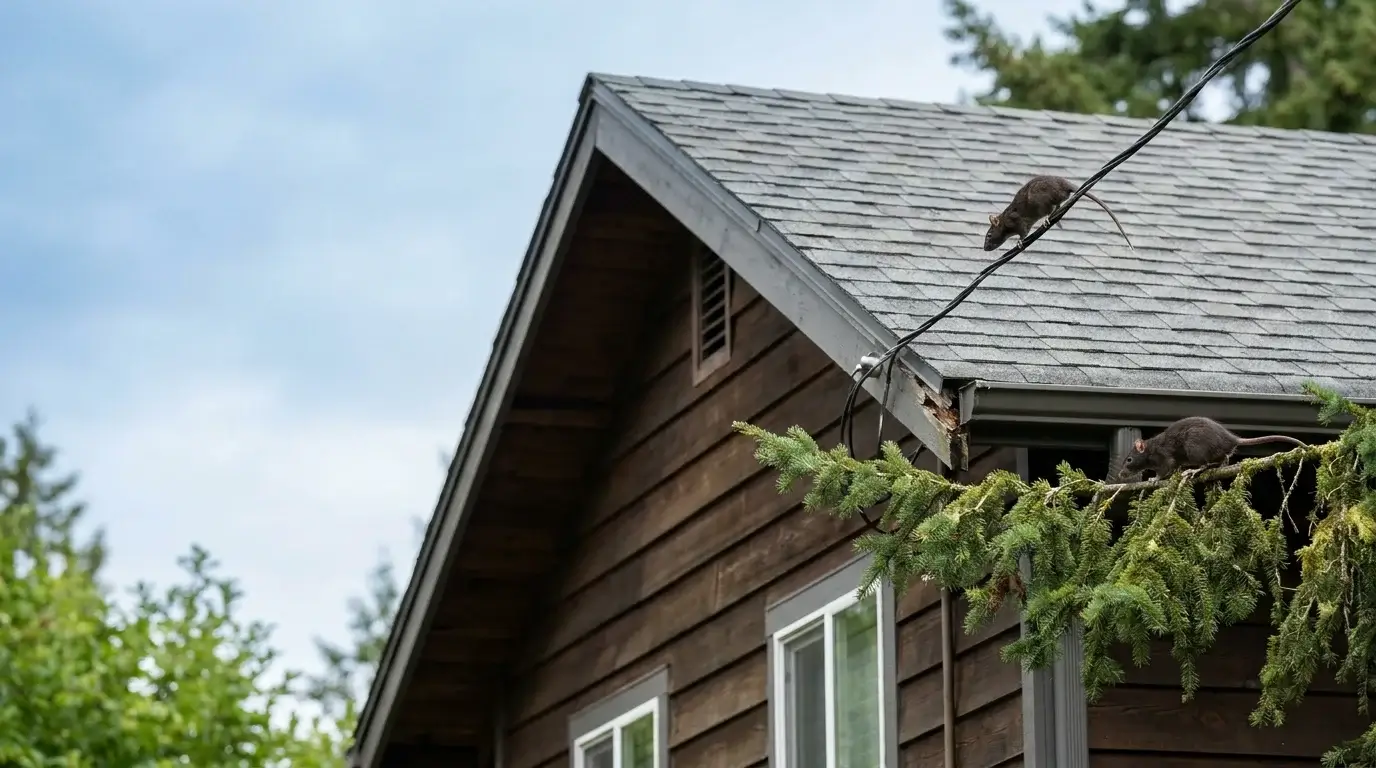
An attic is nearly ideal for a rat: warm, dry, quiet and full of insulation for nesting. Getting there takes some effort, but rats are excellent climbers and jumpers, and they only need a gap about 1/2 inch wide to enter. Most attic infestations begin with an overlooked opening high on the house and an easy route up to it.
This guide explains the pathways rats use to reach attics in Renton and King County homes, the roofline weak points they exploit, and what you can do to reduce the risk. Because many of these spots are high up, we also cover when it is safer to leave the inspection to someone else.
Why Rats Head for the Attic
Attics offer shelter from rain and predators, stable temperatures and materials to shred into nests. In the Pacific Northwest, wet and cold weather from fall through winter pushes rodents to look for dry shelter, and a quiet attic over a heated home is hard to resist. Roof rats in particular prefer to nest high, but Norway rats can and do climb to attics when the opportunity is there.
Once inside, rats chew insulation, wiring and ducting, and leave droppings and urine that can contaminate the space. See our attic cleanup page for what that damage can look like.
The Routes Rats Use to Reach the Roof
Trees and overhanging branches
A branch that touches or hangs near the roof is a bridge. Rats can run along limbs and drop onto shingles or step straight onto a fascia board. Mature evergreens, fruit trees and dense climbing vines close to the house are common culprits. A gap of a few feet may not stop a determined rat, so cut branches back well clear of the roofline.
Utility lines and cables
Power, phone, cable and internet lines that run from poles or nearby trees to the house work like tightropes. Rats follow them easily. You cannot remove utility lines, but you can watch where they land on the building and check the point where they enter the wall or roof.
Fences, sheds and neighboring structures
Fence tops, trellises, pergolas, sheds and detached garages let rats step up toward the roof level. Climbing plants such as ivy on walls give them a ladder. Keeping these elements trimmed back and away from the house takes away easy stepping stones.
Walls and downspouts
Rough siding, brick, pipes and downspouts are all climbable. Rats can scale a surprising range of vertical surfaces, particularly textured ones or those covered in vines.
Common Entry Points at the Roofline
Once a rat is at roof level, it looks for a gap. Check these areas:
- Soffits and fascia: Warped, damaged or poorly fitted panels leave gaps. Rats chew at weak or rotted wood to widen them.
- Gable vents and roof vents: Missing, torn or loose screens are a direct opening into the attic.
- Roof-to-wall joints: Where a roof meets a wall, chimney or addition, flashing can lift and leave gaps.
- Plumbing stacks and other roof penetrations: The seal around a pipe or vent can crack or pull away.
- Eaves and gaps under shingles: Damaged or lifted edges and gaps at the eaves can be enough.
- Utility entry points: Holes where cables or conduit enter the house are often larger than the line itself.
Rats can also enter from below, climbing up inside wall voids from a crawl space or garage. If activity is only in the attic, the entry point may not be at the roof at all. Our crawl space page covers that lower-level route.
Signs Rats Are Using Your Attic
- Scratching, scurrying, gnawing or thumping overhead, especially at night.
- Droppings about 1/2 to 3/4 inch long with blunt ends (Norway rats), or smaller pointed ones (roof rats), along beams and insulation.
- Greasy rub marks along rafters, pipes or entry holes.
- Chewed wires, ducts or stored items, and shredded insulation or nesting material.
- A stale, musty or ammonia-like odor, or in serious cases a smell of decay (see our dead rat smell page).
Noises alone do not tell you which animal is responsible. Squirrels, raccoons and birds also use attics, so confirmation is important.
How to Reduce the Risk
- Trim trees. Cut branches back from the roof and walls, and thin out vines on the house.
- Inspect from the ground. With binoculars, scan the soffits, fascia, vents and flashing for damage, gaps and missing screens.
- Repair rotted or damaged wood. Rats will enlarge soft spots, so repair them with durable materials.
- Cover vents with hardware cloth. Use sturdy metal mesh secured firmly, not just pushed into place. Foam alone is not a barrier because rats can chew through it.
- Seal around penetrations. Use sheet metal, mortar or metal mesh held with sealant where lines and pipes enter.
- Reduce food sources. Pick up fallen fruit and nuts, secure garbage and keep pet food and bird seed indoors or in sealed containers.
Our rodent exclusion page explains how proper proofing fits together. One important point: sealing a home with rats still inside can trap them in the walls or attic. Confirm that the space is clear before closing the last openings.
Staying Safe in the Attic
If you do go up, wear gloves, eye protection and a respirator, and watch your footing on joists. Do not sweep or vacuum droppings dry, since that can stir up dust. Ventilate the area, wet-disinfect surfaces and follow Washington State Department of Health and CDC guidance. Read our safe cleanup guide and, for health background, our hantavirus guide.
When to Call a Professional
Get help when:
- You hear regular activity overhead or find fresh droppings in the attic.
- Entry points are on steep or high rooflines, where climbing is unsafe.
- You are unsure whether you are dealing with rats, mice or another animal.
- There is damaged insulation, chewed wiring or a strong odor.
- You have sealed obvious gaps and the activity continues.
A provider can inspect the whole roofline and attic, identify how rats are getting in and recommend trapping, exclusion and cleanup as needed. See our rat removal page for what to expect.
Need Help Finding a Provider?
Renton Rodent Control is a referral service. We do not perform pest control ourselves. We connect homeowners, renters and property managers in Renton and King County with independent pest-control providers, where coverage is available. Provider availability, services and pricing vary.
Request a Connection
Quick FAQ
How high can rats climb to reach an attic?
Rats climb trees, pipes, wires and rough walls with ease, so height alone rarely stops them.
How small an opening do rats need?
About 1/2 inch. Mice can use gaps of only about 1/4 inch.
Will trimming trees solve the problem?
It removes a major route, but rats can also use utility lines, fences and walls, so trimming works best with sealing.
Is it safe to clean up attic droppings myself?
Small amounts can be handled with proper precautions, but large amounts or hard-to-reach areas are better left to a professional.
Disclaimer: This article is for general education and does not replace an on-site inspection or professional or medical advice. Renton Rodent Control is an independent referral service and does not provide extermination or repair services.