
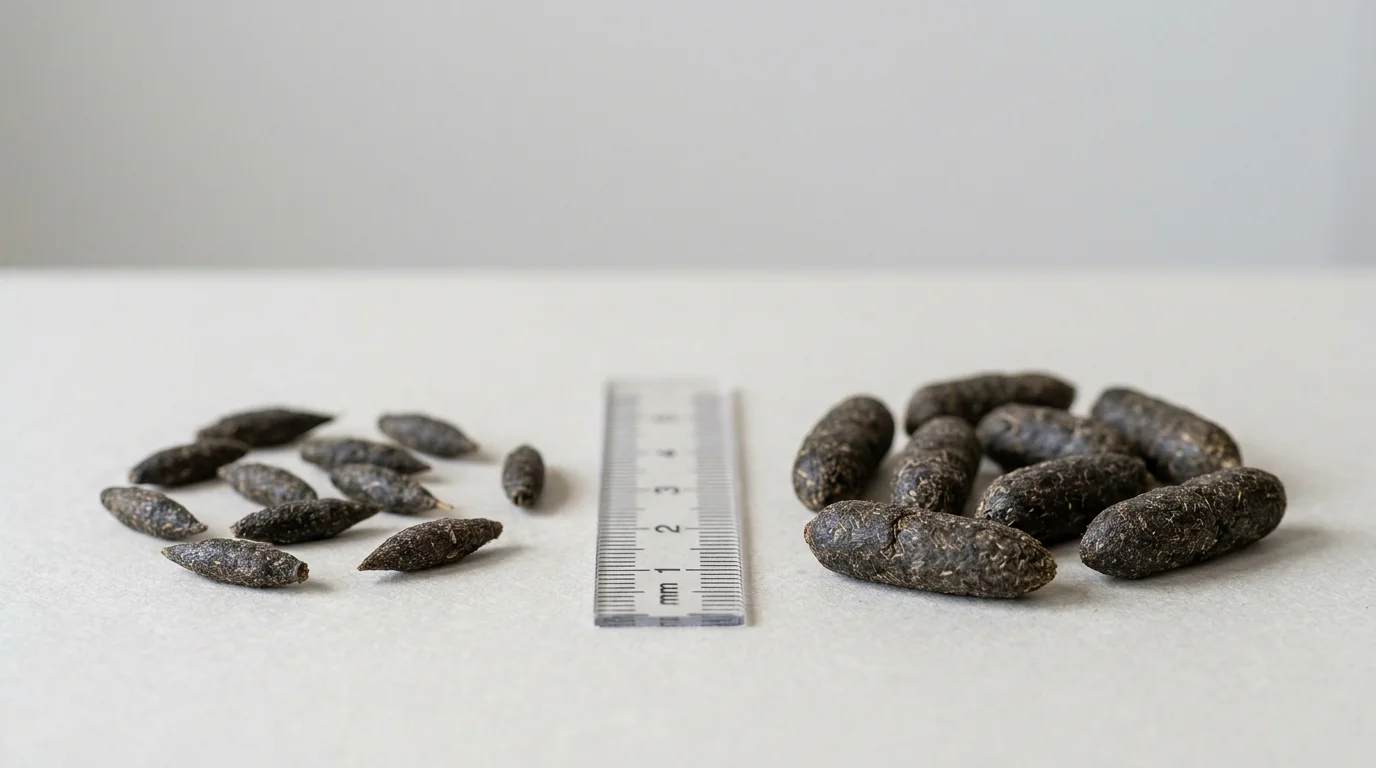
Finding droppings in a cupboard, garage or attic is often the first sign that rodents have moved in. Before you decide what to do next, it helps to know which animal left them. Mice and rats call for different approaches, and the droppings are one of the easiest clues to read.
This guide explains how to tell the two apart by size, shape, color and location, what the differences mean for your home, and how to handle droppings safely. It is a starting point, not a diagnosis, because other animals and even insects can leave similar-looking signs.
Mouse Droppings: What to Look For
Mouse droppings are small and easy to mistake for dirt, coffee grounds or grains of dark rice. Typical features include:
- Size: about 1/8 to 1/4 inch long.
- Shape: slender with pointed or tapered ends.
- Color: dark brown or black when fresh, turning grayer and crumbly as they age.
- Quantity: scattered widely, often dozens or even hundreds in one area, because mice leave droppings as they travel and feed.
You will usually find them along baseboards, inside drawers and cabinets, behind appliances, in pantry corners, and near stored food. Because mice nibble in many spots, droppings tend to be spread out rather than piled in one place. If you suspect mice, see our overview of mice control for the bigger picture.
Rat Droppings: What to Look For
Rat droppings are noticeably larger, and the shape depends on the species.
- Size: about 1/2 to 3/4 inch long.
- Shape: thick with blunt or rounded ends. Norway rat droppings are often capsule-shaped, while roof rat droppings tend to be somewhat thinner and more tapered.
- Color: dark and moist when fresh, fading and hardening over time.
- Quantity: often found in groups or clusters along regular travel routes or near nesting and feeding spots.
Common locations include basements, crawl spaces, along foundation walls, under decks, in attics and near garbage or compost areas. For species details, see our pages on Norway rat removal and roof rat removal.
Side-by-Side Comparison
- Length: mouse about 1/8 to 1/4 inch; rat about 1/2 to 3/4 inch.
- Ends: mouse pointed; rat blunt (or slightly tapered for roof rats).
- Pattern: mouse scattered; rat clustered or concentrated.
- Typical spots: mouse in kitchens, pantries, cabinets and wall voids; rat in basements, crawl spaces, attics and outdoor travel routes.
Other Things That Can Look Like Droppings
Not every dark speck is a rodent. Cockroach droppings are much smaller and look like ground pepper or coffee grounds. Bat droppings (guano) are similar in size to mouse droppings but crumble into a shiny powder because of insect parts, and they are usually found below roosting spots. Lizard or bird droppings often have a white, chalky tip. If you are unsure, take clear photos with a coin or ruler beside the droppings for scale.
Why Size Matters
Size tells you more than curiosity. Mice can squeeze through gaps of about 1/4 inch, while rats need roughly 1/2 inch. Knowing which animal you have helps you understand how they are getting in, where they are likely nesting, and which areas of the home to check first. Droppings that are mouse-sized in a kitchen call for a different search than rat-sized droppings in a crawl space. Our guide to rodent exclusion explains how entry points are typically sealed.
Fresh vs. Old Droppings
Fresh droppings are dark, shiny and soft. Old ones are dull, dry and crumble when touched. Seeing only old droppings may mean the activity ended, but fresh ones in the same spot after cleanup point to an active problem. Never test by poking or breaking them apart, because that can release particles into the air.
Safe Cleanup Basics
Rodent droppings, urine and nesting material can carry germs. Follow these well-established precautions, and see our full guide to safe rodent dropping cleanup:
- Never dry sweep or vacuum droppings. This can send particles into the air where they can be inhaled.
- Ventilate the area by opening doors and windows for a while before you begin.
- Wear gloves and a respirator suited to the task.
- Wet-disinfect: spray the droppings and surrounding surfaces with a disinfectant until damp, let it sit as the label directs, then wipe up with paper towels.
- Bag the waste, dispose of it, remove gloves carefully and wash your hands thoroughly.
For health questions about hantavirus and other rodent-borne illness, consult the Washington State Department of Health and the CDC. Our hantavirus guide summarizes the basics.
Practical Tips After You Identify Droppings
- Photograph the droppings and note where you found them.
- Store food in sealed containers and clean up crumbs.
- Look for gnaw marks, greasy rub marks, nests and entry holes.
- Seal small gaps and trim vegetation away from the foundation.
- Check back after cleaning to see whether new droppings appear.
When to Call a Professional
Consider reaching out to a pest-control provider if you find fresh droppings repeatedly, if droppings appear in several rooms, if you hear noises in walls or ceilings, or if you cannot find how the animals are getting in. Large accumulations in attics or crawl spaces, or any situation where you feel unsafe cleaning up yourself, are also good reasons to get help. See our pages on attic cleanup and crawl space services for related situations.
Need Help Finding a Provider?
Renton Rodent Control is a referral service that connects homeowners, renters and property managers in Renton and King County with independent pest-control providers where coverage is available. Availability, services and pricing vary by provider and location.
Request a Connection
Quick FAQ
Can I tell the species from droppings alone? Size and shape give strong hints, but they are not definitive. A professional inspection can confirm the species.
Are old droppings still a health concern? They can be. Treat all droppings with the same precautions and never sweep or vacuum them dry.
Do droppings mean I have an infestation? Not always, but repeated or fresh droppings usually mean active rodents. Monitor and act promptly.
Where can I learn more? See our FAQ page.
This article is for general education only and is not a substitute for an on-site inspection or professional or medical advice. Renton Rodent Control is an independent referral service and does not provide extermination or repair services.